Saturday, May 13, 2006

India


The Daily Star
Metropolitan

Poor Have Little Access to Better Education

Speakers tell publication ceremony of HalkhataStaff CorrespondentPrincipal Secretary to the prime minister Kamaluddin Siddiqui yesterday expressed deep concern over the division in education system saying its consequences will be dangerous if the division between the rich and the poor is not minimised on an emergency basis.

Kamaluddin Siddiqui said the rich are sending their children abroad or educating them in the best educational institutions, whereas children of the poor are getting education at lower standard institutions.

"As a result children of the rich are getting better jobs depriving the poor and this deprivation will bring dangerous consequences," he cautioned while speaking as chief guest at a publication ceremony of Halkhata, an annual report on primary education by Sushikkha Andolon, a citizens' movement on quality education.

The principal secretary said irregularities in teachers' recruitment, low standard textbooks and lack of teachers' training have downgraded the standard of education.

He specially blamed the authors assigned by the National Textbooks Curriculum Board (NTCB) for making many mistakes in the textbooks.

"I had to blacklist a number of such teachers as they failed to play their due role in writing text books," he added.

The demand of the poor for quality education should be strongly articulated, Kamal said, adding that the Sushikkha Andolon is contributing to the process by creating awareness among the people at all levels.

Speaking as special guest Bangladesh Bank Governor Salehuddin Ahmed said education today has become coaching-centred and teachers-centred where the poor have little access to better education.

Mismatches between the need for education and curriculum of the textbooks are also a setback for better education, he said, adding, "Money is never a constraint for education sector, but what we need is goodwill and participation of all."

Considering quality education as the crucial challenge AKA Shamsuddin, secretary to primary and mass education ministry, said early childhood education, participation of citizens in primary education process, regular monitoring of school activities by thana and district level officials are must to meet the demand.

Activating the school management committees, building adequate infrastructures and reducing the teachers' involvement in non-educational activities are also important to fulfil the goal of quality education, he said.

Presenting the annual report on primary education Sushikkha Andolon member Khandaker Sakhawat Ali said allocation for primary education has increased, but it is not utilised properly.
He suggested community's participation and regular school visits by eminent personalities of the localities as a means to create awareness for quality education in the society.

Education expert Mamataz Jahan considered nutrition of poor children, completion of syllabus and complementary activities for primary education are some major conditions for developing quality education.

Presiding over the publication ceremony Prof Wahiduddin Mahmud said Bangladesh has achieved a number of successes in different sectors including reduction in birth and child mortality rate and increasing enrolment of girl children.

"This is a revolutionary change in comparison to African and some South Asian countries, but we need to sustain the achievements," he said.

Hua Du, country representative of Asian Development Bank (ADB), said a number of measures including building infrastructures, balancing teachers-students ratio and training of teachers have been undertaken to ensure quality primary education under the Second Primary Education Development Programme (PEDP II).

Modernisation of madrasa education can contribute a lot to the development of quality primary education in the country, said Hua Du of ADB, one of the donors in PEDP II.

Co-ordinator of Sushikkha Andolon Dr Hossain Zillur Rahman, Prof Amirul Islam of North South University, Prof Bazlul Mobin Chowdhury of Independent University and Muhammad Mohsin of Plan Bangladesh also spoke on the occasion.

Montana

The enthusiasm is there, now let's see the program.

Billingsgazette.com

Guest Opinion: All-day Kindergarten Valuable, But Raises Funding Concerns

Gov. Brian Schweitzer has announced his support for an initiative to make all-day kindergarten available across our state. Rural schools are well aware of the compelling research that continues to point to the importance of early childhood education, and we support the governor in identifying this priority. Many of our schools have been leaders in innovative programs designed to expand early childhood and kindergarten opportunities across our state.

Our support of all-day kindergarten and the increased funding that this will involve at the state level are, however, something that rural schools consider with mixed emotions. While the increased funding necessary for this worthy program will be touted by many as they point to the state's increased commitment to adequately funding K-12 education, the harsh reality is that this new increase, like much of the money handed to schools during the 2005 special session, continues to be distributed using a completely broken and illogical system of school funding.

Rural schools worry that the great failures of the legislative process during this interim period will continue to haunt Montana as we strive to fairly and adequately fund schools, both large and small, across this state. The fact is that the Quality Schools Interim Committee established by the 2005 Legislature failed in its mission to design a new school funding system after months of agonizing meetings and thousands of taxpayer dollars spent on the process.

Here's just a few (of the dozens) of the issues and challenges related to our state's continued use of a broken system that would shock the private citizen, taxpayer and business person if the same were true of their personal finances or business accounts:

Our state has never penciled out what it actually costs to provide the quality education as identified by the full Legislature during the regular session in Senate Bill 152. In short Montana has no clue what it should actually cost to provide a quality K-12 education as guaranteed by our state constitution!

Montana has virtually no useful information with regards to school facilities and buildings and how these critical capital expenditures relate to providing a quality education.

Funding provided by the 2005 special session, channeled through the same old broken distribution system, placed over 100 schools districts across our state in the situation of needing to return to the local voter to ask to return to previous budget levels or to request a modest increase over last years funding levels. Projections on the funds that would be given schools included huge seemingly illogical increases for some districts while slighting others, forcing them to return to local voters.All-day kindergarten deserves to be a priority for the state of Montana.

Rural schools will swallow hard and support this worthy program knowing full well that the increased funding will not be distributed fairly to our schools because of a broken funding system that, despite a Supreme Court opinion, still has not been fixed.Dave Puyear is the executive director of the Montana Rural Education Association representing school districts across the state and headquartered in Helena.

Indiana

Indiana - in the southern part - has a problem with day care. Apparently it is not age appropriate to teach very young children - that's a kindergarten job. If early childhood educators can't find room to teach children who attend day care, why should there be funding?

Group Says Indiana Lags in Funding for Preschool

A national early education group on Wednesday singled out Gov. Mitch Daniels among leaders of states still in the "pre-k wilderness."

The report from Pre-K Now, a Washington-based advocacy group, says governors in most states are proposing expansions of state-funded prekindergarten programs for the third year in a row. But Indiana is among 10 states that offer virtually no money for preschool.

"Governor Daniels presides over a state with a more stable revenue projection than it did just one year ago," Libby Doggett, the group's executive director, said in a news release. "Leadership and continued discussion of young children's educations is still very much in need in Indiana."

Romania

Romania Says Child Care Woes Not Rampant

May 11, 2006

ASSOCIATED PRESS

TIMISOARA, Romania -- Romanian health officials acknowledged problems Wednesday in caring for disabled and abandoned children, but disputed allegations by a U.S. human rights group of widespread neglect and abuse.

The government confirmed findings in a report by Washington-based Mental Disability Rights International (MDRI) that children had been living in inhumane conditions in a psychiatric ward for adults in the eastern city of Braila.

Officials said the Braila case was uncovered in 2005 and authorities have since closed the hospital and moved the children to a new facility.

"I was in Braila and I saw that the conditions there were absolutely inhumane," said Bogdan Panait, who heads the National Authority for Protection of Children's Rights.

He conceded that problems still existed and said some of the most serious shortcomings should be resolved this year.

The western city of Timisoara's Center for Nutritional Recuperation also was criticized in the report.

On Wednesday, toddlers there napped on quilts, wearing clean pajamas in modern wards with clean, tiled floors.

Local officials disputed the group's findings.

The report is "confused, incomplete and irrelevant to the situation in Timisoara," said Mihai Gafencu, who manages the center.

MDRI experts reported that the 65 children housed in the facility weren't allowed to get off their beds because the institution was short-staffed.

Gafencu, who is also deputy chairman of Romania's Save the Children group, said MDRI had visited the hospital in February, while children were resting and napping after lunch.

Romania's poor treatment of those with mental illness, especially children, became known after leader Nicolae Ceausescu was overthrown and executed in 1989.

Romania

Lest we forget...

Prezent - Images from Romanian child care centers

A team formed of Prezent weekly reporters and journalists from the American TV station ABC went to several children care centers to see the living conditions of mentally disabled children.

The American journalists were interested both in the children who were mentioned in the report made public by the Mental Disability Rights International (MDRI) organization, quoted on Wednesday by the New York Times but also in the children in other centers that had not been visited by the American organization.

In some of these centers, the patients are given a correct medical treatment, they live decently and are given proper food, in other centers (which were not quoted in the MDRI report but were visited by the ABC-Prezent team), the buildings are almost collapsing on the children and the latter are beaten almost daily.

The feature made by ABC-Prezent was broadcast by ABC on May 10 and was also quoted by the Washington Post. The team of journalists was accompanied by one of the MDRI investigators. It has to be noted that, despite the hurried excuses made by the Romanian authorities, none of the images presented are from 2004 or older, as they were filmed in the last couple of months and the more recent were shot at the end of April this year.

The Prichindel center in Alexandria is well supported financially and the children here live in decent conditions. The 16 children have a doctor and live in rooms of one or two people. The investment in Prichindel was of one million euros and the patients are carefully treated. They call the nurses "mom" and the latter actually behave like mothers.

Unfortunately the situation is not the same in all such centers in Romania. In the center in Costesti, Vrancea County, there are 46 children and only four nurses in one shift. The hospital is in renovation and the patients survive in conditions that are hard to imagine. In some of the beds there are two children sleeping. The team of reporters found a room with "vegetable-children" which were eating thread.

"What can they do? They are consuming their energy," a nurse "reassured" us, being not at all worried by the children's behavior.

Thursday, May 11, 2006

The Garden School Tattler

We had an interesting day today. It was rainy, so we stayed indoors for breakfast, and after breakfast, we put the kindergarten and first grades together and played a new bingo game with words. I made the bingo game with the words we have been studying in my class. There were about 40 words in blocks on a page. Every child got an 11 x 14 sheet and a handfull of pennies.

I called out the words one by one, and the children scrambled to find the word on the page and put down their penny. Then they turned to their neighbor to see if they could help. I was excited to see Jackie Snyder get up every word and show the preschool children at the next table where they could find the word. Not one teacher suggested that anyone help another, but several children including Ty acted with such social awareness, I was thrilled.

One of the big day cares is closing in EVV. We've already gotten some calls. It's hard to explain to people exactly what we do and why. Today's activity with the word bingo would have been an excellent explanation. We're a cohesive group that cares about the next guy.

With all the studies, the comments, the cries for 4-K across the nation, it always stuns me that the same old day care plan is the only thing that can be discussed. When nearly forty places on the map can easily be identified by the children, when four year olds can do addition, can find words on the page, when they can learn a foreign language, the same old day care plan seems really fraudulent - almost like theft.

What are parents paying for when the learning is non existent? Miss Kelly told me that in her former teaching gig, she was told not to teach the children anything, that teaching and learning were not "age appropriate" and that learning was for kindergarten. This is from the best childcare in EVV.

Teaching and learning is for everyone. We all read Jabberwocky the other day, and Miss Jana and Miss Kelly laughed as they slowly managed Lewis Carroll's words. I laughed too and gave my own rendition of a few lines that sounded different from the others, but then I'm on the other side of the great vowel shift, so my pronunciation is slightly different. Just then, Mrs. St. Louis came from the kitchen with the whole thing memorized and trilling off her lips like a rosary prayer. It was really a funny occasion, and all the teachers learned while the children watched. This is what they should see, this is what learning means. It was great exchange.

There are so many occasions when we learn from one another and the children should be part of that, so how do you explain all that to new people?

Wednesday, May 10, 2006

Picking the Right Preschool

It's always a combination of classroom activities and play activities. When you combine the work and play, the children learn best. Children like to work at things - provided they are discovering new information and new angles on play.

Picking the Right Preschool
Amanda Dobbins / Parenting

Carey Killian of Portland, Ore., was torn about where to send her daughter to preschool: one that spent a lot of time on academics, to prep Skylar for kindergarten, or one where the kids were mostly playing?

Many parents worry that their children will miss out or fall behind if they don't learn letters and numbers in preschool.

This couldn't be further from the truth, says Kathy Hirsh-Pasek, Ph.D., coauthor of "Einstein Never Used Flashcards." "Children learn by doing, exploring and having fun," she says.

Learning faster isn't necessarily better.

When you visit a school, ask these questions to get a sense of whether it'll be a good fit for your child:

What do the lesson and activity plans look like? Find out if there's an emphasis on things like singing and sharing.

Are there goals that kids are expected to reach during the year? Watch out for ones that seem too strict (count to 20 by December) and look for more socially oriented ones (play well in groups).

How much structure is there in a day? Kids do well with some order in their days, but there should be plenty of time for free play.

United Arab Emirates

DM To Set up Dhs8 m Day Care Centre at Dubai Women's College

Dubai Municipality will set up a Dhs8 million day care centre at Dubai Women's College to serve children of the college's students and staff.

United Arab Emirates: Monday, May 08 - 2006
Essa Al Maidour

Announcing this, Essa Al Maidour, Assistant Director General of the Municipality for General Projects Affairs, said the civic body's initiative is aimed at encouraging female students, who are mothers, to carry on with their studies.

"Educating women means their empowerment. Being a mother does not mean the end of the road and we at Dubai Municipality are proud to announce this initiative which will go a long way in helping young mothers to cope with the double pressures of attending classes and caring for their new-borns," said Al Maidour.

He added that the project, to be set up at an area of 2333 square meters, would include eight divisions with a total capacity of 150 kids in the age-group of 3 months to 4 years. The centre would consist of a playground, activities hall, multi-purpose hall, cafeteria, administration and services blocks.

"The centre was designed in a unique way as there will be natural lighting from all parts. The premises will be covered in lush green vegetation thereby providing a fitting atmosphere for the toddlers to spend the day time," Al Maidour added.

Dubai Municipality is planning to finalise designs of the project by the end of this month and start construction works by June 2006. The centre is expected to be ready by the end of this year.

Tuesday, May 09, 2006

The Garden School Tattler

Near Question: I see that you can't post a thought on this blog without getting belittled.

Who is "you" and what constitutes thought?

What we try to teach the children at the Garden School is the vast human difference between thoughtless knee-jerk reactions - impulses, and truly thoughtful impressions, questions and responses. It takes a few weeks for some children to catch on, but there is a difference, and learning the difference at 3,4,5,6 and 7 gives any child a big head start.

Responsibility is another misnomer in the world today. The idea that I take responsibility for my thoughts words and deeds is all but gone, and the blame is always someone else's. It's tantamount to tattling. It's never my fault, and I never meant, and I was only. HMMMM. I never inhaled.

Communication is an act of love. Whether it is affection or admonition, everything we do should be done because we love. Is our brief time worth spending on hostility and hatred? I don't think so.

Today was another gorgeous day. We are expecting rain tomorrow. We had lunch on the patio. We started reading a book about Tinkerbell who is the pot and pans fairy. It's well done.

My little champions are dashing through math and reading like pros. Today we tackled: this, that, is, a, an, and, but, the, and the number words. Most of the children know the printed number word because of the hints that each word has: One has one little head. Two has two cross bars, three has ee at the end, four has one, two, three, four letters, five has an Ichabod with one eye, six has two sticks, seven has a hallow on the s to rhyme with heaven, eight has a number eight in it, nine is that ninnie number, and ten is easy because we can sound it out.

Our printing is fabulous, and the spacing is coming along nicely.

We pointed out Chile, the Gulf of Mexico and South Africa today. I'm sharing some of the book I'm reading at home with the children. It's about whaling and South Sea travel and adventure. It was published in the 30s.

Homemade cookies for snack - chocolate chip with granola.

The rest of the day was uneventful.

Garden School Tattler

Response: It just seems the way you wrote it that you meant the others weren't as good because they couldn't or didn't make it as far. Sometimes you are too vague and it is difficult to tell what you mean.

If I were the kind of person who preferred one sex to another, one child to another, or who thought a child was not as "good" for any reason, I wouldn't have lasted in this job for 25 years.

Vague exists in not in what I write but in what the reader is looking for. If you are looking for negativity, you can find it anywhere. In fact, you can make it up as you go.

To honor one child because he did something wonderful is not to condemn the other children. We are not all going to glow at the same time, and what I find with children is that each one shines in his or her own way, and I want to comment on those things. This is where you find the talent and this is where you point the child.

If the idea was not to reward those children who did well, where would the bonding come from and where would the trust come from?

Monday, May 08, 2006

The Garden School Tattler Question and Answer

Q: It is insane to think you can get children of that age to write 1-100 in the same amount of time. Maybe you didn't give them enough time. If most of them made it to 40-60 than that is the norm. Correct?

If stupid was for sale...

If it were insane to think a child can do something they can do then the world is upside down. This child wanted to do it, and at age four it is imperative that he be told he can do anything he puts his heart and head to. To discourage a four year old is planting the explosives that will destroy his life. Show me an adult who can't, and I'll show you a mother who didn't.

Time is important to a classroom project. If there is too much time, the children will be bored. So letting someone struggle with something too long is not teaching - it's coercive. Setting time limitations - friendly time limitations - builds trust. Trust is essential to teaching. Children won't learn from someone they don't trust.

As far as norm goes - hilarious - there are no norms. Every child at four and five learns in a unique and gratifying way. Check out Howard Gardener. Presenting a problem to a group of four and fives gives as many project responses as there are children - duh.

The one thing a group of four and fives want more than anything is the adventure of learning and that means discovery, so a teacher offers unique and interesting things children can try out. Trying out stuff is part of learning to manage inner strengths, the passions, if you like. There are eleven passions, and each one needs to be directed.

Asking intelligent questions is the mark of an intelligent person. Asking questions that antagonize and require obvious answers is the mark of a finch.

California

Great article. It's true that if a child doesn't know how to listen aggressively, he can't learn anything else. "Listen to the directions." We say it a hundred times a day.

Today in school we worked on writing our numbers from 1 to 100. One little boy, Justin, who is categorically not old enough for Kindergarten did it beautifully without a flaw.

Other children got to 40, 50 and 60 before the time was up.

We taught science today - an appreciation of the sea and giant creatures both past and present. The children were all very vocal and very interested and most of the listened.

One of the things we really don't tolerate well is tattling. "Solve it," we tell them. Unless there are tears, someone is tattling.

Interesting what people expect.

Silicon Valley Study Examines Kindergartners' Preparedness
The survey finds that children in San Mateo County are better prepared than those in Santa Clara County
By Dana Hull
KNIGHT RIDDER

Most children in Silicon Valley start kindergarten with a good grasp of the basic skills teachers say they need -- from the alphabet to knowing how to sit still -- according to a survey released last week.

But the survey of kindergarten teachers and parents discovered major differences in the skills young students bring to the classroom -- and found that children in San Mateo County are generally better prepared than those in Santa Clara County.

Educators and parents are increasingly focused on the concept of "kindergarten readiness," in part because kindergarten is more academically rigorous than it was a generation ago. The survey, conducted by the Santa Clara County Partnership for School Readiness and the Peninsula Partnership for Children, Youth and Families, is sure to generate discussion -- particularly with a proposal for universal preschool on California's June ballot.
Among the findings:

• Just less than half of children in the two counties are well-equipped in a wide range of categories, including motor skills, social expression, kindergarten academics and self-regulation -- a category that includes the ability to sit still, listen and solve conflicts. Twelve percent have significant catching up to do in all of those areas. The remaining children are stronger in some categories and weaker in others: They might be able to count to 10, but have no self-control, for instance, or the other way around.

• Children generally arrive at kindergarten least proficient in academics, but that is the area teachers say they are most able to influence. Children with self-regulation problems pose a bigger challenge, the survey found.

• Children who manage conflict well are most likely to be ready for kindergarten, the survey found. Other factors: a well-educated mother, being at least five years old and attending preschool.

• Teachers don't expect children to have mastered all 20 of the skills the survey examined. Seventy-four percent of kindergartners in San Mateo County met teachers' expectations in terms of overall readiness -- though they may not be proficient in all areas -- compared with 62 percent in Santa Clara County.

The survey marks the first time that the two counties have combined their data for analysis; last year, Santa Clara did a "Ready for School" survey on its own.

"By looking at this at the county level, we get a better lay of the land," said Lori Burns of United Way Silicon Valley, one of the local group's spearheading Santa Clara County's School Readiness efforts. "We're making progress, but we're not there yet. San Mateo County should get a lot of credit."

It's not entirely clear why San Mateo County children appear to be more prepared to enter kindergarten. But the survey yields two important clues: A higher portion of children in San Mateo are attending preschool, and San Mateo parents say they spend more time on enrichment activities.

"We don't want to shy away from the differences," said Burns, who says she hopes that Santa Clara County leaders will look closely at the report and see it as a call to action. "We want to figure out what we should invest in going forward."

The survey included a representative sample of more than 1,400 children in 76 kindergarten classrooms in 38 school districts. Kindergarten teachers across both counties observed how children did on 20 different "readiness" skills, from how they managed conflicts to their ability to pay attention during circle time.

"This gives all of us a common language by which to evaluate student readiness," said Santa Clara County schools chief Colleen Wilcox. "We know that we can teach academics, but I don't know if we can teach self-regulation. Is it something that can be taught, or is it neurologically developed?"

Local kindergarten teachers say they can immediately tell if a child has attended preschool or not.

"The ones who didn't go to preschool run around and push each other and act like they are at home, so it's hard for us because we need to go through the basics of getting them used to a routine," said Cristina Oterino, a kindergarten teacher at Seven Trees School in the Franklin McKinley School District in San Jose. "They need to understand the difference between play time, quiet time and listening time. If they can't follow directions, they can't learn anything else."

Sunday, May 07, 2006

India

This project actually gets to the child and little money was put into the project.
Newindpress on Sunday

A lesson learned
Friday May 5 2006
Nandini Murali

At the morning assembly, a group of 20 girls and boys aged three to five years sing the prayer song joyfully. Once that is done, they get busy with their daily lessons. They chant nursery rhymes in Tamil and English and lisp their way through action songs. Revathi, their pre-school teacher, unfolds the numbers, alphabets and colours charts, all made using local low-cost materials.

Welcome to the community preschool run by the Deepam SHG (Self-Help Group) at Sengalinurodai in Ramanathapuram district. But for Deepam and Revathi many of these children would be left at home, with no one to take care of them, as their mothers set out to work in the fields.

Take four-year-old Shyla Rani, for instance. Until Revathi convinced her parents — tappers by profession — to send Shyla and her siblings to school, she spent her day taking care of her two younger brothers, one of whom was only two years old. Shyla’s elder sister would take care of the housekeeping. Only after repeated reassurance from Revathi that their children would be well looked after did the parents agree to send them to school.

Child-centered, activity-based learning is the hallmark of the 20 SHG-run community preschools initiated in 1995 at Ramanathapuram district by the Association for Integrated Rural Development (AIRD), a non-governmental organisation and member of the Network for Education and Empowerment of Rural Artisans, a development network in Tamil Nadu.

The SHG-managed system of community-based, community-owned and community-managed preschools for children of low income group parents, was developed by the Palmyrah Workers Development Society (PWDS), an NGO based in Kanyakumari. It has been adapted by AIRD to local contexts and needs.

Poverty, illiteracy, lack of accessibility to government schools, and discrimination against girls demanded such a need-based intervention rooted in local culture and tradition. In 1995, AIRD started ten community preschools with the participation of SHG members in villages where there were no government primary schools or balwadis.

In an effort to identify and develop local leadership, AIRD identified girls like Revathi from nearby villages and trained them in preschool teaching methodology. AIRD also supported the teacher’s salary, supplied teaching material, provided nutritional counselling to parents, and conducted half-yearly health camps for the children in association with local primary health centres (PHCs).

By 1998, the number of preschools increased to 20. A community preschool federation was formed with one representative member from each of the 20 preschool centres. The SHGs also involved the government in the activities of the preschool. ‘‘We submitted petitions to the collector and asked the government to open schools in villages where there were no schools,’’ says Kalimuthu, a member of the Deepam Federation.

Their repeated attempts resulted in the preschool centres being able to access the Tamil Nadu government’s mid-day meal programme. The PHCs also supported the healthcare needs of the children by offering free medical check-ups and immunisation services.

In 2003, the SHGs supported the staff salary by collecting Rs 25 as fee for a child. Besides SHG members contributed money or rice to supply food for the children on a daily basis. As a result of the people's efforts to mainstream, the district administration took over 12 of the 20 preschool centres. The other four centres have been integrated with the Tamil Nadu Integrated Nutrition Project and two others are supported by religious institutions.

Today, the community preschool concept exists in 120 villages. ‘‘We have moved from direct services to advocacy. Every child has a right to education. Isolated interventions will not help. We are working through people’s organisations at the field, and at district and policy levels for sustainable impact,’’ says V Gopal, Programme Coordinator, Community Child Education Programme, AIRD.

The MS Swaminathan Research Foundation in Chennai recently selected the PWDS community pre-school model as one of the ten model case studies in the country. The pre-school initiative illustrates successful blend of self-help, alternatives, and mainstreaming strategies. The community preschool model originally envisaged as an alternative is today mainstreamed. The principle of mainstreaming involves shifting issues from the periphery to the centre. It means that policy makers and those delivering services need to comprehend the specific needs, difficulties, and inequalities the communities face.

Childcare Funding

This is where some of the budget for "Childcare" goes. Goes to show that the focus seems to be away from the young child, and "early" childhood education.

Child-care advocates worried about shortfalls in budget
By Alan Gomez
Palm Beach Post Capital Bureau
Friday, May 05, 2006

TALLAHASSEE — Children will fare well from the record increases in education spending currently in the state budget, but child-care advocates worry about what the rest of the $71.3 billion budget holds.

The budget includes smaller-than-expected increases for the Department of Juvenile Justice; a program that helps children leaving foster care; and the Guardian Ad Litem program, which helps children who have been abused or neglected.

"The children have gone largely unheard," said Roy Miller, president of the Children's Campaign Inc., a nonprofit advocacy organization.

Juvenile justice was a contentious issue this session, with the death of 14-year-old Martin Lee Anderson after a beating at a state boot camp putting the department in the spotlight. That camp was run by the Bay County Sheriff's Office and led to a total revamping of boot camps in the state.

But money for other services shopped out to private contractors by the department also irked some child advocates.

Last week, negotiators in the House and Senate agreed to spend an extra $33 million on contracted services for juvenile justice, a 10 percent increase over last year, bringing the total to $363 million.

That increase was far less than the $100 million the contractors, who provide 80 percent of juvenile justice services, had requested to stabilize the agency. But even that increase was slashed when the budget was released — down to $20 million.

"Providers are very concerned about being the next headline," said Mark Fontaine, executive director of the Florida Juvenile Justice Association that represents the contractors.

Department Secretary Anthony Schembri was pleased with other gains in his budget, including a $4.6 million increase in salaries, $1.5 million to increase closed-circuit security systems in 10 detention centers around the state and $300,000 to increase staff training.

Child advocates were pleased with moderate increases in other programs, but said more needs to be done.

Road to Independence, a program that helps children leaving the foster care system at age 18 adjust to life on their own, received a $5 million boost to its $21 million budget. But the program had asked for $10 million.

That boost could also be complemented by a $2.8 million addition of health coverage under the state's Medicaid program for teens going through that transition.

That addition, contained in HB 7173, has been approved by the House, but has not been voted on by the Senate.

"I know very few youngsters who turn 18 and can totally fend for themselves," said Andrea Moore of Florida's Children First. "They need this help."

Moore said legislators did an inadequate job increasing money for the Guardian Ad Litem program, which uses volunteers to represent abused and neglected children in the county's court system.

Advocates had pushed for a $13 million increase to the $27 million program, but secured only an extra $8 million.

"There is nothing more important they could have done to ensure the safety of children," Moore said.

Allergies

This doesn't surprise me. Childcare is mostly done in very small rooms, crowded and airless. Some childcare rooms don't even have windows. The air is circulated, the lighting is poor, and the children get 15 minutes of fresh air on some days. Children spend 100% of thier time cooped up in inadequate rooms - OF COURSE CHILDREN ARE SUSCEPTABLE TO ALLERGIES.

NEW YORK (Reuters Health) -

Preschool age children who attend day care have a heightened risk of developing respiratory and allergy symptoms, according to results of a study conducted by Swedish researchers.

Dr. Linda Hagerhed-Engman, of SP Swedish National Testing and Research Institute, Boras and colleagues examined the effect of day care attendance and age on respiratory and allergic diseases in children between the ages of 1 and 6 years.

The parents of more than 10,800 children completed a cross-sectional survey. Along with respiratory and allergy symptoms, questions focused on the home environment and information about day care.

In the last 12 months, compared with children in home care, children in day care had more symptoms, including an increased risk of 33 percent for wheeze; 56 percent for cough at night; 23 percent for doctor diagnosed asthma; 15 percent for rhinitis; 75 percent for doctor diagnosed hay fever; 49 percent for eczema; and 27 percent for food allergy.

In addition, the odds of having more than six colds in the last 12 months was increased by more than 2.5-fold, and for ever having an ear infection by more than 2.0-fold, among children attending day care.

The increased risks were most pronounced for the youngest group of children, those between the ages of 1 and 4 years.

In light of the significant increases in allergic diseases in Sweden over the last decades, the researchers conclude that the "findings justify a significant public health concern."

Jamaica

Every time I see a story like this I wonder the same things I always wonder: how much of this money will the children see? Probably none. A half a million dollars is set aside for children, and everyone but the children receive it. It goes to programs about early childhood education. It goes to studies about children. It goes to education about early childhood, but the day to day bleakness of childcare remains in the state of bleakness. It happens all over the world.

Ministry of Finance & Planning

Jamaica Signs US$559,000 Grant Agreement for Early Childhood Education
KINGSTON(JIS)Friday, May 05, 2006

The Government today (May 4), signed a US$559,000 grant agreement for Early Childhood education with the World Bank, under the Japanese government's Policy and Human Resources Development (PHRD) Fund.

The agreement was signed by Minister of Finance and Planning, Dr. Omar Davies, who chaired the ceremony; Japanese Ambassador to Jamaica, Hiroshi Sakurai; and Director, Caribbean Country Management Unit, Latin America and the Caribbean Region of the World Bank, Caroline Anstey, at the Ministry in Kingston.In his address, the Japanese Ambassador said the agreement represented yet another initiative highlighting the combined partnerships between the governments and peoples of Japan and Jamaica toward progress and understanding.

He said education should be given special attention as investment in knowledge was the cure for unsafe communities, healthy countries and the increasing number of disadvantaged citizens.

"The earlier we start to invest in knowledge, the sooner we are healed," the Ambassador remarked, emphasizing that early childhood education was critical to nation building. The Ambassador expressed the hope that much effort would be placed on arriving at strategies for the development of the personnel within early childhood facilities, such as administrators and teachers, and not just on those who were responsible for regulation.

"It is necessary to build a strong regulatory framework for the early childhood education sector. However, we must ensure that the issues of knowledge, facility, and personnel be dealt with in parallel, otherwise the result will be frustration. I hope that this initiative will see equitable value for regulators and the regulated," he said.

The PHRD Fund was established in 1990 as a partnership between the Government of Japan and the World Bank.

In her remarks, Chair of the Early Childhood Commission, Dr. Maureen Samms Vaughn, thanked the Bank for its support and commitment. She said the funds would be used to "provide us with the information that we need to ensure effective planning and efficient use of resources".

Dr. Samms Vaughn assured that the information to be obtained would be comprehensive. "It will not only address areas of governance and policy, but it will also address issues at the classroom level. I am also pleased to report that it addresses health and our most vulnerable citizens, children with disabilities," she said.

Miss Anstey commended the Jamaican government for its focus on early childhood education and thanked the government of Japan for its support for the project through the PHRD grant.

"Early childhood education is crucial for inclusion, later school performance, for helping people lift themselves out of poverty and indeed for crime reduction," she said.She informed that to date, 95 per cent of four to six year olds in the island were enrolled in school, but "we still have to focus very much on the cohort of one to three year olds, and in particular on the poorest members of the community and those with disabilities".

The Director pointed out that the project would help to ensure that this cohort had proper access to facilities and quality education, which was the Early Childhood Commission's focus.

Areas for consideration under the early childhood programme include policy and governance; children at risk; parenting and public education; quality improvement in early childhood institutions; monitoring and evaluation; and training for early childhood practitioners.

The grant will provide technical assistance to put the essential building blocks in place to support an effective early childhood development programme.

Through a range of studies and surveys, the grant will inform the preparation of initiatives that could be supported through future investments. The recommendations from these surveys will form the basis for a future loan agreement with the World Bank, which is scheduled to begin in 2008.

Friday, May 05, 2006

Garden School Tattler

Last night I became a grandmother again. Patrick Joseph was born to my son and daughter in law. A wonderful 7.14, 21.5 little boy with maybe red hair and blue eyes. Mother and child doing fine.

It's always a blessing when it all goes well. Patrick joins his sister, Elizabeth, who will be three this month and Sam who is fifteen.

On the school front, it's time to plant the garden! It's such an exciting time. The weather is beautiful, the children are beginning to show signs of tan, the Popsicle event is expected every day, and there is shade on the playground - the trees are all out.

We're finishing up with "What do you know" month, and so far our map is LOADED with little plastic boats. The children know dozens of places. "That's New Zealand," said Austin. "I know where Chili is," said Hadley.

Today, Mrs. St. Louis pulled out a couple of dozen maps and explained maps. The kids were fascinated. "There are mountains on this map, and camping spots on this one, look at the little tents," said Mrs. St. Louis. After the children inspected several maps, they went to tables and each drew a map of a place they invented. It was all very wonderful.

We did some homemade play dough, and the children just loved it. Homemade play dough is a salt clay mix of 2 cups flour and one cup salt, a dash of oil and a cup of hot water. Double or tripple for a crowd. This play dough lasts about a week and won't stain carpets.

Then we had lunch on the patio. We had homemade bread sticks with garlic butter or homemade cheese sauce. We had Ravioli, a big salad, grapes and bananas, celery and dip and milk.

For treats we had Cheerio marshmallow brownies and Popsicles.

Monday we continue "What do you know." I think it's science week.

Fiji

I thought this was really dear.

Fiji Times

Day Care Centre Cherishes Children
Wednesday, May 03, 2006

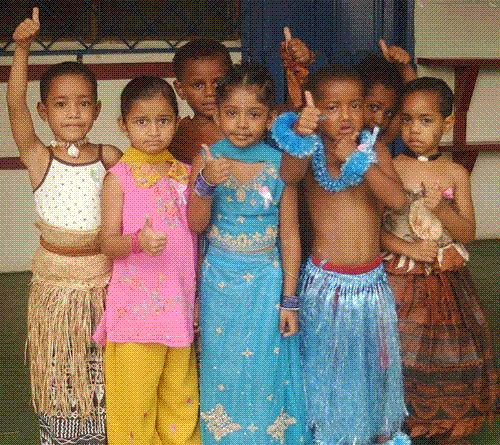
A DAY care centre in Lautoka celebrated Children's Day by having children dress up in their traditional costumes and entertaining the teachers with items.

Prasad's Day Care Centre owner Savita Prasad said the half-day celebrations were in keeping with the event theme, 'Keeping our children connected to family, community and culture.'

"We thought to do something after I read in The Fiji Times on April 7 about it and also because Lautoka was not doing anything," Mrs Prasad said.

"Teachers made paper costumes for the children to wear for the 15 items they performed.
"The teachers also performed two items for the children.

"We also had organised games for the children like bun-eating competition, sack race, book-on-head but because it was rainy this morning we did more indoor activities."

Mrs Prasad said it was the second time the centre celebrated the occasion because she believed it was important.

"Children are achievements of the future and if a day is given to them, it makes them feel important and helps in their confidence building," she said.

"This way we build their self-worth and self-esteem and they know they are loved by the community."

She said children from two-and-a-half to five years of age took part in the celebrations.

Malaysia

This is a good comparison article. It's not so different in the West. It kind of shows you why standardization is so impossible.

Malaysia Star
Child Care Is N Child’s Play

It’s a familiar dilemma: Finding someone to mind the baby when the parents are at work. The solution for thousands of affected families: the so-called ‘babysitter’. The result? A burgeoning industry comprising mostly unlicensed and untrained child-minders and day care centres. It’s a situation that Women, Family and Community Development Minister Datuk Seri Shahrizat Abdul Jalil finds highly unsatisfactory and she tells DAPHNE LEE how she plans to tackle the problem.

As a working mother of three, I know how hard it is to juggle a job and family. However, I have a relatively easy time as I’m lucky enough to have the help of a wonderful Indonesian nanny.

Kak Kholida has looked after my three children, lovingly and competently, from birth and, before she came to share our home eight years ago, she helped out at the home-based day care I sent my eldest son to. The lady who ran that place was also an excellent carer and an ex-staff nurse to boot.

Many other parents are not as fortunate. While they hope for quality care for their children, reality dictates that their priority is finding a babysitting service that is located conveniently near their home or workplace. Naturally, cost is also a consideration.

Of course, all parents hope that their children will be well cared for, but not many expect day care facilities to provide more than supervision and regular and well-balanced meals. Even safety, which everyone would agree is of supreme importance, often seems to be taken for granted.

Boom-bang-a-bang ... Nursheila receiving some TLC from one of the young ones at the country’s first community day care centre.Devi, an IT technician with a 15-month-old baby and a three-year-old, declares that the most important thing for her is that her children are given good food and get enough rest at the babysitter’s.

“The minder is a friend of my mother’s,” says Devi. “She runs a clean household and my kids are not exposed to cigarette smoke or foul language.”

She is taken aback when asked if the babysitter is familiar with first aid procedures like cardio-pulmonary resuscitation or the Heimlich manoeuvre.

“I’ve never asked her or even thought about that,” she admits. “Actually, I doubt that she would know how to do those things. I chose this babysitter simply because she has experience.”
Others assume they have chosen the right babysitter based on word-of-mouth.

Sales clerk Loke, a father of a three-month-old baby girl, for example, chose a day care centre that was recommended by friends. “This centre has been operating for many years so it must be a safe place to leave my daughter.”

However, the recent case of the death of two-and-a-half-month-old Brandon Teh while in the care of child minders has given Loke pause. “Yes, I am worried, but we are both working and there is no one else to look after the baby. At least the day care centre I use has a good reputation.”

Brandon’s parents probably felt that they were leaving their baby in good hands too, but found that their faith was misplaced when he died from asphyxiation at his day nursery.

The couple, Vincent Teh and Rowena Yong, are currently in the process of taking legal action against the Petaling Jaya nursery and its owner, citing criminal negligence as the cause of their son’s death.

The nursery was apparently operating without a licence. While this is worrying, it is actually the rule rather than the exception for nurseries and other childcare facilities to run without a permit. Statistics released by the Social Welfare Department at the end of last month show that, nationwide, a mere 1,831 childcare centres are issued with permits.

“It is a real problem,” acknowledges Women, Family and Community Development Minister Datuk Seri Shahrizat Abdul Jalil during an exclusive interview with StarMag.

“Childcare centres come under my ministry and it is very important that these places are safe for children and deliver quality care.”

Shahrizat gets up close and personal with some of the children at Taska Penyayang Bakti.Shahrizat says that the ministry, with the Social Welfare Department, is doing its utmost to encourage day care centres as well as home-based carers to register themselves.

“The care of children from birth to the age of four comes under the department,” explains Shahrizat.

“The department is in charge of issuing permits to childcare centres. However, it can only do so on the condition these centres meet the approval of the local authority, the Fire and Rescue Department and the Health Department.”

The minister adds that because local authorities tend to see day care centres as business enterprises, permits have to be renewed on a yearly basis.

“This we feel is unfair and impractical,” says Shahrizat, “because we feel that childcare is really a social service that is very important to the proper growth and development of a child. So, we are trying to help as many centres as possible to register themselves.”

Shahrizat says parents who use day care facilities could help by finding out if the service they use has a permit and informing the ministry or the department accordingly.

There is a penalty of a RM1,000 fine or two-year prison sentence for the owners of centres without a permit. However, the minister prefers to use a non-punitive, humanitarian approach in encouraging centres to apply for permits.

The interview was conducted at Taska Penyayang Bakti, a childcare centre in Kuala Lumpur that is the first of 10 that will be launched, nationwide, by the Women, Family and Community Development Ministry and the Social Welfare Department this year.

These centres will be run by associations or organisations that are recognised by the Government and will receive grants to subsidise the cost of caring for the children and ensure that they are equipped with state-of-the-art facilities.

“We are very excited about our centres,” enthuses Shahrizat while playing with the children of the taska, which is located in Bandar Sri Damansara.

For the past one year the ministry has been reviewing the Child Care Centre Act 1984 and has been talking to childcare practitioners and others involved in children’s welfare.

“What we realise is that are many gaps in the curricula and infrastructure of childcare centres, as well as the law governing them.

“I’m happy to say that we are now ready to submit proposals to amend the Child Care Centre Act. These amendments are based on concerns for safety, quality of care and the training of child minders.”

Shahrizat says she hopes that the government-recognised day care centres will set a benchmark for quality care. “These centres will provide the best in early childhood care and education. They will have trained staff as well as the best facilities.”

She adds that she wants to encourage staff of day care centres to enrol in the 19-day basic childcare course, conducted by the Social Welfare Department.

“The course costs just RM480 and covers essential topics such as nutrition and hygiene and storytelling and physical activities. It is a small price for operators to pay if they want their staff to deliver the best care.”

Taska Penyayang Bakti, which will be officially launched in June, is run by the Association of Registered Childcare Providers Malaysia (ARCPM) and all the carers at this centre are experienced and have done either the basic or advanced childcare course.

“The first three to four years of life is a critical time in a child’s mental, physical and emotional development so it’s very important that children should be given the best care during this period by trained care-givers,” says ARCPM president Norsheila Abdullah.

Shahrizat agrees that this fact cannot be stressed enough. “That is why we are planning a holistic approach in our childcare initiatives.

“Our community day care centres are just the tip of the iceberg. We also encourage home-based babysitters to attend the basic course and register with the department.”

Perhaps the most encouraging news about the new community day care centres is that the services they offer will be available to low-income families at a subsidised rate.

“Those who earn less than RM2,000 a month will pay just RM100 a month,” says Norsheila.
“However, parents who earn more may also enrol their children as it is hoped that the centres will be places that promote social as well as racial integration. Of course, priority will be given to low-income families.”

Would parents like Loke and Devi consider sending their children to a community day care centre?

Both say that it would depend on the location of the centre, and Devi adds, “It really does not matter who runs a centre as long as the children are treated well and not abused or neglected.

“Advanced learning techniques and modern equipment are a plus, but the most important thing is a caring environment where the children experience joy.”

Shahrizat would approve of such sentiments. She says, “It is important to prepare children to face life by giving them the best education, but we must never rob them of their childhood.”

For more information on the guidelines for setting up nurseries in Malaysia, contact the Department of Social Welfare’s Law and Advocacy division at 03-2697 1090 or go to the department’s website at jkm.gov.my.

Thursday, May 04, 2006

California

It's a must have even though we don't know exactly what it is or should be.

CAMPAIGN 2006 Preschool Politics Pros and Cons of Universal Education Initiative Aired
Janine DeFao, Chronicle Staff Writer
Wednesday, May 3, 2006

Amanda Riccetti supports universal preschool, but she plans to vote against Proposition 82.
Director of Big City Montessori School in San Francisco's Bayview district, Riccetti fears the June ballot initiative to provide free preschool to all California 4-year-olds is so restrictive that schools like hers will be shut out.

"The initiative puts in very precise directions, making it more difficult for programs to be individualized and for parent choice," said Riccetti, who runs a school for 100 children founded by her mother in 1972. It has been turned down as a site for San Francisco's fledgling universal preschool program, though Riccetti is working to qualify it.

The ballot measure -- with prominent Democrats, Republicans and chambers of commerce lined up on either side -- also is dividing preschool providers.

Initiative backers say Prop. 82 would create a system in which all existing preschools could apply for state funding to offer the program, including public, private and faith-based centers and even family day care providers. But current preschool leaders worry about a range of issues, from requirements that teachers earn bachelor's degrees to the creation of standards for what preschoolers should learn.

With a tax hike on California's highest earners of 1.7 percent, Prop. 82 would generate an estimated $2.4 billion to fund half-day preschool programs by 2010 for California's half-million 4-year-olds. Between 62 and 65 percent of 4-year-olds attend some form of preschool now, but backers of the measure say many schools are low quality; as few as 20 percent may attend quality programs. And many communities, particularly in poor areas, don't have enough preschool spots. Private preschool typically costs more than $4,000 a year.

Prop. 82 would more than double public subsidies for preschool in California. But waiting lists for subsidized care are long, and many poor families earn too much to qualify for programs such as Head Start.

The measure aims to resolve the quality issue by increasing teacher qualifications and setting standards for preschool that would be aligned with the state's standards for kindergartens through third grades. Some educators worry that curricula will be pushed down to younger ages, as has happened in the K-12 system.

"The premise is great, but it's not all quite adding up," said Karen Zimmerman, director of ABC Preschool in Alameda, who plans to vote against the measure. "If you're pushing academics at four and leaving behind the social and emotional issues they need to have under their belts to get along in the world, you're leaving a big part behind."

Scott Moore, director of a group known as ECE4PFA, which represents 45,000 early child educators who support Prop. 82, said educators have little cause to worry because the standards would be developmentally appropriate and allow a variety of curricula.

"All preschool philosophies should meet those developmental standards," said Moore, co-owner of Little Elephant Montessori School in Oakland.

But some other Montessori schools have organized against the measure, claiming it could drive them out of business unless they drastically alter their teaching methods.

"Why would I want to turn over a vibrant, healthy model to a highly challenged bureaucracy that needs to address its own issues?" said Pamela Rigg, president of the California Montessori Council, which includes about 80 of the state's more than 500 Montessori schools.

The new state preschool system would be led by the state superintendent for public instruction, and funding would be dispersed by county offices of education, except in San Francisco and Los Angeles, which have already developed their own systems.

A survey of more than 400 preschool directors by UC Berkeley education Professor Bruce Fuller, who has raised numerous questions about Prop. 82, found that 53 percent opposed state preschool standards and 56 percent did not believe preschool activities should aim to raise elementary school test scores.

"There's a deep worry in the nonprofit sector over the possibility that Sacramento might exert more control," Fuller said of his preliminary results.

But initiative backers say the new system would be designed to maintain the diversity of approaches in use by relying on existing providers to participate, as pioneers such as the state of Georgia have done.

"This is one of the first systems in the nation where private providers are part of it, where parents have choice," Moore said. "This is drastically different than the K-12 system."
Educators such as Peter Glassman of the Early Learning Institute worry that state control will lead to unhealthy standardization.

"I'm afraid that an extraordinary amount of goodwill and sincerity will result in a system that will not succeed in its objectives and will inevitably force providers into a model that will not succeed for young learners," said Glassman, vice president for curriculum and instruction for the institute, which operates Montessori preschools and K-8 schools in Palo Alto, Pleasanton and San Jose. Glassman's schools are not affiliated with Rigg's group.

Under the initiative, faith-based providers could participate in universal preschool, but only if they did not teach religion during the state-funded school day. At Temple Sinai Preschool in Oakland, director Melanie Sandberg said religion is such a key part of instruction that she would opt out of the state program. But Sandberg supports the initiative and said she isn't worried about competition from free preschool because parents would continue to pay for religious education.

California Church Impact, the sister organization of the California Council of Churches, which represents 1.5 million Christians, opposes the measure because of concerns about standardizing preschool education, Impact public policy director Elizabeth Sholes said.

Another controversial issue among preschool providers is the proposition's requirement that teachers earn bachelor's degrees and a yet-to-be-created early childhood credential.

Supporters say such a degree is necessary to raise quality. Salaries would be expected to double, placing them on par with K-12 teachers', and the high turnover rate would drop.

But others worry that the requirement would disproportionately hurt the high number of minority and immigrant preschool teachers and worry that the current educational system is not up to the task.

Fuller's survey found 37 percent of providers supported requiting a bachelor of arts degree, while 43 percent preferred a two-year degree.

Only a third of teachers in state-funded preschools now have B.A.s. The initiative contains $500 million for higher education institutions to expand training and $200 million for financial aid, and the degree would not be required until 2014.

"There's no question it's a herculean task," Moore said. "But the fact is you've got eight years to do it and a lot of resources to make it accessible and affordable."

Schools also would have to decide whether to require bachelor's degrees for those who teach children younger than 4 and then figure out how to pay higher salaries without the state funding. That could increase fees.

Paul Miller, executive director of Kidango -- a nonprofit that runs 40 centers in the East Bay, San Francisco and San Jose -- said he would raise salaries across the board. He hopes the state would raise its subsidies for children younger than 4 as well.

"A lot of programs are fearful of the unknown," Miller said. But "the question for me really isn't, 'Is this better for Kidango?' The decision I made is, 'Is this better for children?' It is."

Moms

This was sent by Hadley's Mom.

Description of MothersWhy God made Moms -- BRILLIANT Answers given by 2nd grade schoolchildren to the following questions!!

Why did God make mothers?
1. She's the only one who knows where the scotch tape is.
2. Mostly to clean the house.
3. To help us out of there when we were getting born.

How did God make mothers?
1. He used dirt, just like for the rest of us.
2. Magic plus super powers and a lot of stirring
3. God made my Mom justthe same like he made me. He Just used bigger parts.

What ingredients are mothers made of?
1. God makes mothers out of clouds and angel hair and everything nice inthe world and one dab of mean.
2. They had to get their start from men's bones. Then they mostly usestring, I think.

Why did God give you Your mother & not some other mom?
1. We're related
2. God knew she likes me a lot more than other people's moms like me.

What kind of little girl was your mom?
1. My mom has always been my mom and none of that other stuff.
2. I don't know because I wasn't there, but my guess would be prettybossy.
3. They say she used to be nice.

What did mom need to know about dad before she married him?
1. His last name.
2. She had to know his background. Like is he a crook? Does he get drunkon beer?
3. Does he make at least $800 a year? Did he say NO to drugs and YES tochores?

Why did your mom marry your dad?
1. My dad makes the best spaghetti in the world. And my Mom eats a lot.
2. She got too old to do anything else with him.
3. My grandma says that Mom didn't have her thinking cap on.

Who's the boss at your house?
1. Mom doesn't want to be boss, but she has to because dad's such a goofball.
2. Mom. You can tell by room inspection. She sees the stuff under thebed.
3. I guess Mom is, but only because she has a lot more to do than dad.

What's the difference between moms & dads?
1. Moms work at work and work at home & dads just go to work at work.
2. Moms know how to talk to teachers without scaring them.
3. Dads are taller & stronger, but moms have all the real power 'causethat's who you got to ask if you want to sleep over at your friend's.
4. Moms have magic, they make you feel better without medicine.

What does your mom do in her spare time?
1. Mothers don't do spare time.
2. To hear her tell it, she pays bills all day long.

What would it take to make your mom perfect?
1. On the inside she's already perfect. Outside, I think some kind ofplastic surgery.
2. Diet. You know, her hair. I'd diet, maybe blue.

If you could change one thing about your Mom, what would it be?
1. She has this weird thing about me keeping my room clean. I'd get ridof that.
2. I'd make my Mom smarter. Then she would know it was my sister who didit and not me.
3. I would like for her to get rid of those invisible eyes on the backof her head.

Japan

It's Their Loss--Most Men Shun Child-care Leave
04/29/2006
BY SAYAKA YAKUSHIJI, CONTRIBUTING WRITER

Masato Yamada was delighted when he heard his wife was pregnant again. They'd tried to have children for 10 years before their first children--twins--had been born two years earlier. The impending birth of a third child was a huge surprise.

But the reaction of his wife, Atsuko, shocked Yamada. She was considering not having the baby at all.

She'd just started a new assignment at work. She liked it and the pregnancy would be a major obstacle.

Yamada, now a 38-year-old official at the Ministry of Economy, Trade and Industry, thought about their situation and devised a solution he hoped would make everyone happy. Instead of his wife, he would take child-care leave.

Why not? They both had the same employer--the economy ministry. He could stay home and take care of the baby. She could continue her new project. On loan from the ministry to a government-affiliated institute, she'd just started research on the Constitution.

Anyway, it seemed like the fair thing to do. It was his turn.

Atsuko agreed, and he took a one-year leave of absence in October 2004 to take care of Takashi, now 18 months old.

Before he made the leap, his former university classmates and colleagues--all government bureaucrats--chastised him, saying it would be an act of sheer lunacy. Government officials are expected to work around-the-clock. If the Diet is in session or if crucial budget negotiations are in progress, you had to be there. Why waste time on a baby, and more importantly, put future promotions at risk for something that was essentially women's work?

Yamada's experience was recounted in book form with the January publication of "Keisansho no Yamada Kacho-hosa, Tadaima Ikukyu-chu" (Yamada, an economy ministry assistant manager, is now on child-care leave).

If Yamada's case sounds unusual, that's because it is. Few dads absent themselves from work for child care in Japan.

A recent Asahi Shimbun survey of 100 major corporations is illustrative. When asked how many male employees had taken child-care leave since 1992--the year the child-care leave law went into effect--more than 30 percent of the firms said zero.

This is especially disappointing because further legislation by the Ministry of Health, Labor and Welfare to promote child-care leave was introduced in April 2005.

The new legislation was instigated by Japan's ever-declining birth rate and the demographic disaster it portends. Known as the "10-year-limit law," companies with more than 300 employees are required to formulate policies to aid child rearing by workers. The government's goal is to have at least 10 percent of men taking child-care leave within 10 years.

Japan's child-care and family-care leave law stipulates that employees can take up to one-year of child-care leave (18 months in special cases). Employees are guaranteed a minimum of 40 percent of their salaries for the duration of the leave period.

A 2004 labor ministry survey of companies with 30 or more employees found that while 78 percent of women have taken a child-care leave, only 0.43 percent men did the same.

"Taking care of the children is still considered the role of the mother," Hiroki Sato and Emiko Takeishi write in their book "Dansei no Ikuji Kyugyo" (Men's child-care leave).

"Social and corporate systems are designed with this idea in mind. Raising children is mainly done by women, while men commit themselves more to their job after having a child," the authors say in their book.

One reason Japanese men are adverse to child-care leave is that employees in their 30s and 40s often work in the neighborhood of 60 hours a week, according to the book. In other words, employer demands on their time peak at the age when they would most likely need to take leave.

Satoshi Hirahara is a 36-year-old employee of a major electronics firm. His company has a generous child-care leave system, yet Hirahara has "never even thought about taking leave" and knows "no male employee who has used the system."

He leaves the child-rearing duties during the week to his wife--a full-time homemaker. He has no intention of taking advantage of his company's child-care benefits, he says.

He says he is afraid that if he took leave he might not get the assignments he wants in the future.

Providing child-care leave presents difficulties for small firms. "Often, an employee is responsible for multiple tasks at a small company and it is very difficult to find someone to replace him for a short time," Koji Harakawa, research manager at the National Federation of Small Business Associations, says.

Social pressure is another factor. Kunihiko Imamura, a 35-year-old researcher in Hiroshima Prefecture, is planning to take three months off in December to care for his now six-month-old daughter, Haruka.

"I don't want to become a father who can work but cannot do housework and child care," he says. Also, he thinks it might be the only opportunity for him to spend a significant amount of time with the baby.

However, when he announced his intentions at the office--he is employed by the Hiroshima prefectural government--he ran into a storm of criticism. Colleagues, while not coming right out and saying it, made it clear they were not happy with his decision. Superiors were less discrete, not to say loud, confrontational and hostile.

One senior employee accused Imamura of being a slacker: "You just want to take it easy by taking the time off, right?"

In fact, taking care of a newborn is far from easy. For Yamada, it was especially tough because he had to take care of twins in addition to the infant.

He also had to learn the ropes in a new environment. While men may still run the business world to a certain degree, when it comes to babies, toddlers and kids, women control the territory.

Yamada says he had a difficult time adjusting to the female-dominated community at his children's kindergarten. To make matters worse, his neighbors gave him the cold shoulder--they apparently didn't approve of an adult male choosing to stay at home when he could be commuting to an office, he says.

Despite the hassles, Yamada says it was worth it. He was able to watch the baby grow day by day--an event he says he could never match with a work-related achievement, even as one of Japan's elite bureaucrats.

This feeling is shared by other fathers who have taken child-care leave. Takahiro Tsuzuku, a 28-year-old systems engineer at IBM Japan Systems Engineering Co., worked late into the night, frequently taking the last train home. And then he took two months off to take care of his daughter, Ayumi.

While taking a walk with the baby near his house in Kashiwa, Chiba Prefecture, he says: "I learned how a baby can be totally out of control. But you still love her because she's your child."

Tsuzuku--the first man to take child-care leave at his company--wants to do it again. "If we ever have another child, I'll ask my wife to work full time while I become a full-time house husband taking a year's leave."

Kosuke Abe, 31, a Sony Corp. employee, has formed "Kozure Okami no Kai" (Lone wolf and cub association), a group of men who have taken child-care leave.

"After taking child-care leave, I felt a strong need to set up a network of fathers," Abe says. "You can get lonely and feel alienated, as if you don't belong anywhere."

Bureaucrat Yamada has little time to feel lonely. He now leaves the ministry at 6 p.m. two days a week to take his kids home from nursery school. And he says he is more dedicated than ever at work, determined not to let his child-care experience damage his career. He says his professional success can serve as an example for other men.

Yamada says he's learned a lot. "Previously, I thought I was driving the Japanese economy. But after meeting mothers in the neighborhood I learned what happiness really means as far as the Japanese public is concerned," he says.

"I also learned tolerance. However idiotic my subordinates may be, at least they understand Japanese and won't suddenly burst out crying," he says, while trying to keep track of the twins running around his Shibuya Ward condo.

Sitting next to her husband, Atsuko smiles, while holding the baby she once considered not having at all.

(IHT/Asahi: April 29,2006)

Wednesday, May 03, 2006

Starting School at the "Right" Age

I love this because I see it all the time. Parents are all concerned that their child is not ready for the big industrial school. It really has to do with how a child is reared. Here are two scenarios, you decide who is ready:

John and Peter have the same birthdays but grow up in different families. Both are only children. John gave up the pacifier at three months. Peter finally gave his up at three years. John was potty trained slightly before his second birthday. Peter was nearly four when he chose to use the toilet. John colored with his parents, learned his letters at three, how to listen at four and played the piano with his mom. Peter's crayons stayed mostly in the box because of the family's white carpet. He learned to sing some TV songs, and did some computer letter games.

We could go on and on. When there are growing up expectations, children simply grow up faster. They are more than ready for the next step - school. A good guideline is: Infancy - 1 year. Toddler - two years. Preschool with Kindergarten - three years.

It's true that lots of people like children to stay young. It's true as well that some children simply stay young on their own. But consider the future. They won't be young at 18. When children are still in high school at 19 because they were held back, there is often a boredom problem that needs to be addressed earlier than 19. It's worth thinking about.

More Boys Finding They're Ahead of the Game When They're Held Behind

BY NARA SCHOENBERG
Chicago Tribune

Like many people who have exited the fast track, Aaron Dorman is happy and fulfilled, with many interests and a full schedule.

What sets him apart is that he is only 4 years old.

After "failing" a creative movement class - he refused to pass the beanbag - and resisting the long separations from a parent or caregiver required in preschool, Aaron settled into a schedule of shorter classes and supervised play that likely will not deliver him to kindergarten by the traditional age of 5.

"I don't know if he's developmentally on the mark or not, and I don't care," says his mother, Bernadette Pawlik, an executive recruiter.

"He's a happy, kind person who takes great joy in life. So what more could I ask for?"

If Aaron continues at his current pace, he will join a surprisingly large, and some say growing demographic: boys whose parents are delaying their entrance into kindergarten until age 6.

Some parents want their children to perform better academically; others worry about the social and emotional effects of starting a boy before he is ready, or of allowing a child with a summer birthday to be the youngest and smallest in his class.

Many of these parents are affluent, educated and aware that because of factors such as mandatory testing, kindergarten is harder than it used to be, with educators referring to it as the "new 1st grade."

Some also have been influenced by research indicating that boys typically mature at a slower rate than girls in key school readiness areas such as language and fine motor skills.

About 11 percent of American boys entered kindergarten a year late in the 1990s, compared with about 6 percent of girls, according to the most recent national study. But those figures may now be outdated.

"We've had this whole No Child Left Behind thing (since 2002), which is really whipping schools to accelerate as much as they can" and making delayed kindergarten entry more attractive, says Leonard Sax, author of "Why Gender Matters: What Parents and Teachers Need to Know about the Emerging Science of Sex Differences."

In his practice as a family physician in affluent Montgomery County, Md., about 1 in 2 boys are starting kindergarten at age 6, compared with 1 in 10 a decade ago.

Another rough indicator, the percentage of boys starting kindergarten at about age 6 or older has gone up, from 7 percent of boys in 1970 to 18 percent in 2001, according to calculations by the U.S. Department of Education.

The number of girls starting kindergarten at about age 6 or older has gone up, too, but from 5 percent in 1970 to a relatively modest 10 percent in 2001.

Some experts object to the practice of holding boys out, also known as redshirting, a reference to the practice of keeping college athletes out of competition for a year in order to extend eligibility.

"There are fairness and equity issues here," says Samuel Meisels, president of the Erikson Institute school of child development, who points out that many parents can't afford the child-care costs involved in delaying kindergarten.

"If you can afford to do this, you're really giving your child an advantage. And, after all, all of our children - we want to give them the greatest advantage. But this is one where class really does play a role, so in a school where there is a mixture of social class, these are kids who are older; these are kids who are bigger. They may in fact get onto the sports team first. They may get the parts in the school play.

"I can't say for sure, but it does change the platform for the start of school, and I'd rather see the starting line be the same for everyone."

But others vehemently defend redshirting, with Sax saying that, due to the academic difficulty of kindergarten and the slower developmental schedule of boys in key areas, 90 percent of boys should be redshirted.

"That argument borders on incoherent," he says of those who criticize redshirting on the grounds of fairness.

"What you're arguing is that affluent parents should disadvantage their kids so as not to give them an unfair leg up on poor kids. I don't think anyone could get the words out if they understood that's what they're saying."

The rise of redshirting dates to the 1980s, when mandatory testing put pressure on schools to make the early elementary grades more rigorous. As 3rd and 4th grade became more demanding, kindergarten had to keep up. Savvy parents were increasingly likely to worry about their children's early academic performance and resort to redshirting, Meisels says.

A parallel national trend of moving back the cutoff age for kindergarten eligibility, making the average child older when he or she began, also contributed to the "graying of kindergarten."

And the more 6-year-olds there were in kindergarten, the harder classes became and the more likely parents were to engage in redshirting.

That process is on display on a blustery winter afternoon outside the Chicago City Day School, where the mother of a boy who started kindergarten at age 5 talks about the effects of widespread redshirting.

"I happen to have a small child and he is so small and so young" compared with the kids who were redshirted, she says, noting that "he definitely has issues" with the situation.

"Why am I so little? Why am I so much smaller? Why can't I run as fast?" he asks his mom, who asks not to be identified because she doesn't want to damage her relationship with the school.

"It's a cycle," she says of redshirting, "Once it starts, what are you supposed to do? You don't want to put your child at a disadvantage."

In one Wisconsin school district, 94 percent of the boys and girls were redshirted, according to a 2000 study co-authored by Beth Graue, an education professor at the University of Wisconsin-Madison. A review of data by the Connecticut department of education found that wealthy districts had redshirt rates of up to 20 percent while some low-income districts had rates of 2 to 3 percent.

Ironically, it's unclear whether a late start to kindergarten helps children in the long run, with one study in the journal Pediatrics actually suggesting the opposite.

The 1997 study co-authored by pediatrician Robert S. Byrd found that teenagers who were older than their classmates because they had started school late were more likely to have behavioral problems than kids who had started on time.

But supporters of redshirting point to the work of researchers such as Harriet Hanlon of Virginia Tech.

"In girls, the areas of the brain involved in fine motor skills, like handwriting and language, are way ahead of where they are in boys, so in those areas the brain of a 5-year-old boy looks like the brain of a 3-year-old girl," Sax says.

"So for most 5-year-old boys, getting them to read and write is like trying to get a 3-year-old girl to read and write. It is not developmentally appropriate."

In the Lake Forest, Ill., First Presbyterian Church Preschool director Ruth Luke says kindergarten has become so demanding that some kids can't keep up.

Among the results she has seen: tutoring for 5-year-olds, parents who agonize about when to enroll their children in kindergarten, and a rise in redshirting.

In one case, she says, a very immature 5-year-old boy had a "disastrous" start in kindergarten. He couldn't sit still or recognize any letters. His parents pulled him out in November and started him again the next year, and he did beautifully the second time around.

"I really can't say I disagree with some of these people," Luke says of parents who redshirt, "because these little guys really struggle, where (for) the 6-year-olds, it's just a piece of cake."

Pawlik says she and her husband were initially concerned by Aaron's reluctance to separate from a caregiver and start preschool, but, after much discussion, they decided it was fine for their son to proceed at his own pace.

"The most important thing is that he have positive feelings about his school experience," Pawlik says.

"And whether he starts preschool at 4 or he starts kindergarten at 5 or 6 - when he's 25 or 30, that's not really going to matter."

For Kristen Weisberg of Lake Forest, Ill., the decision to start her son Porter, 5, in kindergarten next fall at age 6 was a multilayered process, in which she and her husband considered factors such as Porter's summer birthday and their own experiences as relatively old kids in their grade school classes.

Weisberg talked to her male peers about the issue, and the ones that had been young for their classes said they would have preferred to have been older.

She also took into account the availability of a preschool program for 5-year-olds at First Presbyterian Church Preschool.

"It worked out well for me," she says of redshirting. "They all catch up and it all evens out in the end, whether they're smart, half-smart, not smart. But I think later on, especially with guys, they drive first and they have one more year on them as far as height and ability, especially in sports.

"So we'll see. Give me a call in 16, 18 years. We'll do a follow-up story."

Choosing Preschool

This article is exactly why state run preschool won't ever work. Which program is the State going to choose? Which one is better for children? The truth is, every good preschool teaches several different programs because the children learn in several different styles. Incorporating several different styles under one roof is essential. Essential also is understanding teachers and allowing teachers to teach. Too often ideologies conflict with a teacher's abilities. A place touts a certain style, but the teachers can't manage it. Sharing teaching helps, so does team teaching.

Preschools Practice Varied Approaches
But feeling comfortable with the staff is a must
BY LINDSAY KASTNER
TIMES-DISPATCH STAFF WRITER
May 2, 2006


Now It's preschool registration season, and your options include everything from parents' co-ops to church schools.

Some preschools are public, some private. Some focus more on academics, others on play.
Suddenly you have to choose between curricula and such educational philosophies as Montessori, A Beka, Waldorf and Reggio Emilia.

And you thought potty training was hard.

Libby Doggett, executive director of Pre-K Now, an organization that advocates for high-quality preschool options, says choosing the right preschool is important.

But take a deep breath.

While preschool curricula and philosophies can differ vastly, Doggett says, parents don't need a degree in early childhood education to choose a good program.

"There's a huge, huge difference . . . based on kind of a different view of children," Doggett says, but she adds, "There's no one way to raise children, and there are lots of good ways to do it."

Learning something about the curriculum a program touts is good, Doggett says, but feeling comfortable with the staff is fundamental.

She says teachers should have a bachelor's degree and some experience in early childhood education.

"Young children are so different from older children," she says. "They really do learn through play."

At the Circle School last week in Oregon Hill, five children played in a public greenway behind the school.

Director Napi Ippolito helped open the vegetarian parents' co-operative more than two decades ago to give parents with unconventional schedules a high-quality child-care option.

The co-op opened with nighttime hours, and the first parents to participate were musicians, restaurant workers and an ambulance driver.

Ippolito still keeps children until midnight many nights. But these days, she's offering the children breakfasts, too.

Because the school is a co-op, parents pitch in whenever they can.

"Some people have nothing but money and we'll take it," Ippolito said. "But most people have much, much more to offer."

Parents help with everything from food preparation to teaching art and music lessons.
"They'll be called upon to do what they can do best," Ippolito said.

The school does not have much of a budget, but it has "work parties" to complete various projects. A future one involves turning an old tree stump into a fanciful outdoor playhouse.

The Circle School was licensed to care for more than 12 children but recently scaled back. It's not looking to add families at this time. But Ippolito encourages other families to consider starting a co-op tailored to the families involved.

The Circle School draws from the philosophies of the Waldorf schools, which limit television in favor of nature walks and imaginative play, and from the Reggio Emilia approach, based on highly regarded schools in that region of Italy.

Some Circle School graduates now bring their children to the school, which has a compost pile out back and a scraggly garden. A mural of a whale -- painted by Virginia Commonwealth University students -- graces one side of the building.

The day is largely unstructured, but the school is active and plugged into the community. Students from VCU fulfill service learning requirements there, and Ippolito frequently walks with her charges to nearby Belle Isle.
. . .
The hallway at Canterbury Community Nursery School was quiet and empty on a recent morning.

Teachers stood sentinel at open classroom doorways.

Canterbury builds into its schedule a period of time every day when children are free to roam from one room to another spending time in areas with different themes. The school calls this "open time."

When a bell rang, dozens of little feet scurried into the hallway, out of one doorway and into another. The place resembled an ant colony. All of the children seemed to have a destination in mind.

Open time isn't an hour-long free-for-all. Each classroom has a colored flag outside its door: white for the library room, green for the art room.

Children enter a room and attach a colored clothespin to their clothes. No more clothespins, no more kids in that room.

And no aimless wandering in the halls.

When a couple of tots started drifting, they got a gentle admonition from another student.
"You have to go to a room and stay there," he told the other boys.

In the science room, one little boy pounded flowers between layers of muslin, while another looked through a view-finder at pictures of bugs. A plastic bin on the table held a collection of bird nests.

The library room was filled with children who all know how to check out their own books, even though most were too young to read. Canterbury's system includes paper library cards that stay in the room and are labeled with each child's photograph. Older children helped the younger ones.

The school's philosophy is based on the theories of Jean Piaget. It is licensed by the state and accredited by the National Association for the Education of Young Children, two facts in which director Terry Tusing takes great pride.

Doggett said the accreditation is the most rigorous that can be sought.

"Nobody is as strong," she said.
. . .
Richmond-area public school systems offer free preschool programs. They include the federally funded Head Start program for low-income 3and 4-year-olds and the Virginia Preschool Initiative for at-risk 4-year-olds not served by Head Start.

The programs differ a little, but both teach similar skills and incorporate lots of parental involvement.

Gov. Timothy M. Kaine has said he plans to expand public pre-k offerings so all of Virginia's 4-year-olds will have access to public preschool.

Libby Doggett of Pre-K Now says that in considering either a public or a private preschool, parents should "absolutely" visit before enrolling a child.

One thing to look for: teachers who follow the children's lead.

"If the children are really, really interested in dogs," Doggett says, "then they'll do a unit on dogs instead of a unit on farm animals."

Tuesday, May 02, 2006

The Garden School Tattler


Kaito returned home from Japan today and came for a visit. The kids were thrilled to see him. He brought gifts of food for the children and wonderful cookies for the teachers.

The children were inspired with our study of Geography today with the addition of tiny ship model replicas they earn by knowing a place. The ship model has their name and it is pinned onto the map. We picked out Tasmania (Austin) Madagascar (Justin) Egypt (Hadley) and the Arctic Ocean (Adyson).

We sang a Miss Molly Song - There Were Three Jolly Fishermen. The kids loved it.

At home we've been discussing how "flat" the earth is with the burgeoning of technology throughout the third world countries. Lots of your food orders at fast food restaurants are relayed to India as you place an order and by the time your food is delivered at the pick up window, much of the transaction has been done thousands of miles away.

Many questions about all kinds of accounts are often handled in India. Medical transcripts as well are faxed over seas and re-faxed by the next morning to your doctor's desk.

Today I picked up a Japanese medicine, made in Ireland, with Chinese packaging.

At the same time, there are still primitive cultures existing along side us - like the Tree People. We talked about the Tree People today. They still use the South Sea island custom of punishing bad people by ingesting them. Interesting fact among computers, fast food, and medical transcripts.

We live in such a wonderful interesting world. The kids are knee deep in discovery about that world, and they have developed a fantastic vocabulary to ask the most wonderful questions.

Tomorrow we will sit down at tables and look at pictures of the world in books we have collected at school. The Material World is an excellent source, and better still are the Lonely Planet people books. Mrs. St. Louis's son, Regis, writes these books.

My class struggled through the bingo sheet. Most of the children followed the directions and did very well. I was surprised. We will continue to work on this kind of thing.

Today we had roast pork - very delicious - kids loved it. We had watermelon, oranges, noodles, bread and butter, milk, and cottage cheese.

Tomorrow, it's chocolate chip muffins for breakfast.

Monday, May 01, 2006

The Garden School Tattler

There are so many good things in a day it's hard to list them all. We were a little squirrelly today, but we were also filled with energy. Energy is a good thing provided it's managed. Management is a two way street. If you manage yourself, say I, then Miss Judy won't need to manage your time.

We did a whopping nearly $1000.00 in book sales, and we started using the books right away. There is a contest each morning for those who like design. Today we did what looks like a nuclear design. Coloring prize goes to Dawson. We started reading a Tinkerbell book and the kids the characters. I saw them smile.

We started a new geography contest. We are learning the countries and where they are. So far we have had Hadley point out Australia and know it is not a state but a country. Peyton pointed out the South Pole and the United States of America as a country. Jackie pointed out the equator. Mayli pointed out the North Pole. We are working on some of the other places we have studied. It will take time.

I've invented the toughest Bingo game ever. It's a design sheet 11X14. There is no pattern and the uneven shapes all have a number from 1-99. Tomorrow we color the sheet to get familiar with where the numbers are. Then later this week we will try out calling the numbers in a row, then randomly. Should be interesting.

We built words today. Lots of copying. We are learning the number words, is, the, a, and a variety of verbs because we are starting to write a short story. Children will take home copies of the story every day, but the original won't go home till it's done.

Mrs. St. Louis reports all her children know their alphabet, and are working on their numbers to twenty. Please count with your children by touching the objects while you say the number. It's called one to one correspondence.

And while working with children, teach them to use both upper and lower case letters. WILLIAM is not correct. William is, however. When a child comes to school with all caps, it's hard to unteach.

The big question is: "Why won't my five year old learn what other five year olds learn?"

Learning is a separate individual process. Every child, every person learns differently and at a different pace. Some people never learn certain things. Some children are fierce learners, gobbling up information like a fast train gobbling coal. Other children are lackadaisical and ho hum it into grammar school. Still others try but can't. We had one beautiful child who learned when we applied music. The problem is pushing.

By nature, I'm a pusher. "You can do it; trust yourself. Try." But there are times when a child just can't. He or she is just caught in a web of confusion only time will release. And it's important for teachers to know who needs to be pushed and who doesn't.

We've had several children at the GS whose psychologists thought were mentally retarded. With enough time and encouragement, these children went to regular classrooms. What you have to remember is that the parent is the primary educator of the child and with enough attention, and that means turning off TV, a child will finally surface and begin to understand. They will catch up, but all the pushing in the world won't do it. Security and affection will do more for a child's learning than all the pushing in the world.